Ongoing patent strategy, structured invention harvesting, and a clear path from disclosure to filing, on capacity reserved for you.
A full-time patent attorney costs $250K to $450K+ a year once you include benefits and overhead. Most growing companies need in-house-caliber IP judgment, not a full-time salary. Fractional Patent Counsel reserves that judgment for you in defined weekly or monthly hours, and the same attorney who sets your strategy also drafts the applications, so nothing is lost between deciding what to protect and protecting it.
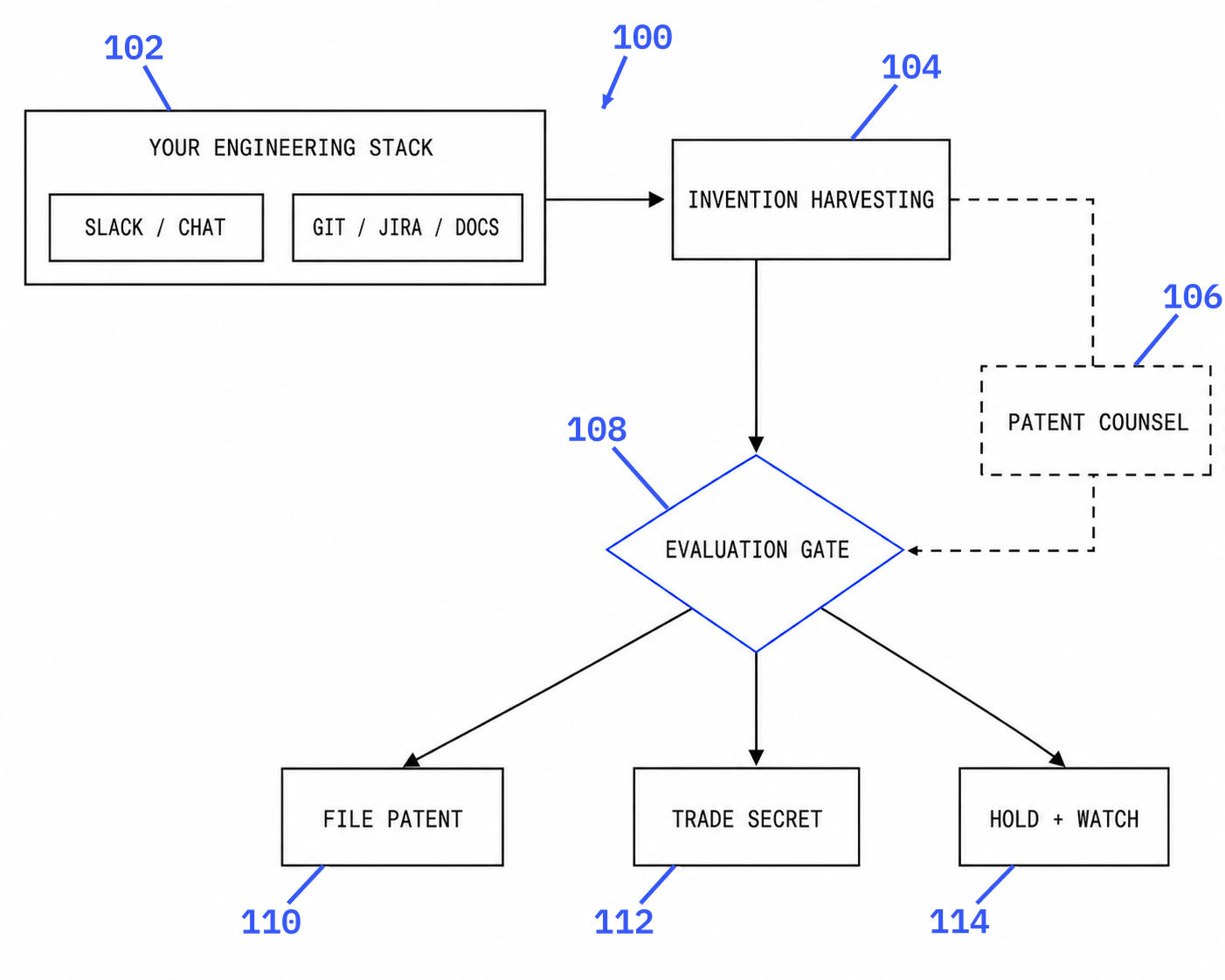
It's a familiar pattern, and an understandable one: heads-down building for two years, then a scramble to file something the week before a fundraise. We replace that with a system (100) that runs continuously, so protectable work is caught when it happens, not remembered later. The numerals below track FIG. 1.
Recurring, attorney-led harvesting sessions plus a structured async intake draw on your engineering stack (102), turning what your engineers are building into invention disclosures ready for review (104). Continuous discovery tooling that connects directly to your systems is available as an optional integration.
Counsel (106) runs each candidate through one evaluation gate (108), scoring it against a standard rubric: novelty, eligibility, detectability, strategic fit, and continuation runway. The strongest get a one-page scorecard and a clear recommendation.
Each candidate is routed to its best outcome: file a patent (110), keep it as a trade secret (112), or hold and watch. Filings begin with prior art review, so claims are drafted with the landscape in view and provisionals hold up when priority matters. Where a trade secret is the better route, we make the call and coordinate implementation with your employment or corporate counsel.
What is not filed today is held and watched (114), revisited every quarter: family reviews, continuation strategy before windows close, landscape monitoring, and docketing oversight. No family goes abandoned without a documented decision.
A standing strategy session plus direct access to your counsel with a defined response window. Ask before you sign, ship, or publish.
Structured harvesting sessions and an async intake process. Every candidate is triaged through our standard gate, with written scorecards for the strongest.
Attorney-drafted provisional and non-provisional applications, scoped separately at fixed fees quoted before work begins, with prior art review on provisionals.
Quarterly review of every open family: claim runway, competitor product movement, and keep-alive recommendations before issuance closes the window.
A monthly briefing on newly published applications and grants in your technology space, including named players, and what the activity means for your roadmap.
Periodic screening-level ranking of your assets by detectability and market exposure, with a concrete path to making core assets assertable.
We watch your deadlines, maintenance fees, and application status across the portfolio and flag everything before it's urgent.
An annual portfolio letter from outside patent counsel, written to be forwarded to your board and dropped into a fundraising data room.
Most growing companies don't need another drafter. They need someone who owns the patent function: deciding what to protect, when, and how, and making sure it actually happens. Every plan reserves a defined block of your counsel's time for the counsel role itself: strategy, invention harvesting and evaluation, portfolio oversight, and direction of outside counsel. Drafting is not part of plan hours; filings are scoped separately as an Application Push or handled by your existing firm under your counsel's direction.
For companies that need experienced patent judgment in place before invention volume picks up.
For companies with steady invention flow that want patent strategy on a consistent footing.
For companies actively building or managing a portfolio, or preparing for a raise, acquisition, or licensing program.
For companies near a raise, exit, or an active licensing or assertion campaign, where IP moves the number.
Focused, fixed-scope work for a specific need, quoted at a fixed fee you approve before anything begins. A defined engagement is often the best way to see how we work before reserving ongoing capacity.
You have invention disclosures and need an expert read on which are worth filing.
You know there is protectable work in your codebase but nothing has been written down.
You have a deadline and a set of inventions that need to be on file before it.
Capacity plans are month to month after a short initial term, or prepaid annually. Scope, reserved hours, and fees are set out in a clear, readable engagement letter before anything starts. Defined engagements are quoted at a fixed fee you approve before work begins. USPTO fees, drawings, and third-party costs are billed at cost. Continuous invention-discovery tooling that integrates with your engineering systems is available as a separately licensed add-on.
In-house patent counsel usually means a full-time hire at $250K to $450K+ a year, more than most growing companies can justify. Fractional Patent Counsel gives you that seniority, backed by an enterprise-grade IP tooling stack, in the hours you actually need, so you get in-house-caliber patent leadership without the full-time cost.
Fractional Patent Counsel is led by a former USPTO patent examiner and USPTO-registered patent attorney with 15+ years of legal experience and more than 500 patent applications drafted, preceded by nearly a decade of industry engineering experience, across complex electrical and computer technologies: AI and machine learning, software systems, autonomous agents, electronics, communications, and cryptographic infrastructure. That work includes drafting and prosecuting patents for established technology companies, patents that became part of significant commercial portfolios, and responding to thousands of office actions over the course of that prosecution.
That experience is hands-on, not just on paper: it includes building and shipping production AI systems, from an AI agent marketplace to an MCP-based verification protocol. When your engineers describe an architecture, whether it runs in a data center or on a circuit board, nothing gets lost in translation, and that fluency shows up in claim quality, faster disclosures, and strategy that matches how technology products actually get built. Working with a fractional patent attorney means that same senior person handles both the strategy and the drafting, on reserved hours rather than a full-time salary.
Reserved capacity means your counsel's time is held for you every week or month, so you can loop counsel in before decisions get made, without a new engagement, a new quote, or a surprise invoice. You get a predictable commitment and priority availability, and the hours flex across whatever matters most that period: strategy, harvesting, evaluation, or portfolio oversight. Pay-as-you-go hourly billing works well for discrete, well-defined matters; reserved capacity fits the continuous, ask-anytime relationship a growing company usually needs.
Filings are not part of plan hours. They are scoped as an Application Push at a fixed fee you approve before work begins, or handled by your existing firm with your counsel setting the strategy and reviewing the work. Either way, every filing has real claims strategy behind it, with prior art review on provisionals. USPTO fees and drawings are billed at cost.
We run conflict checks before every engagement and decline work that overlaps an existing client's space. If your technology later converges with another client's, we tell you early and help you transition that matter to trusted counsel rather than pretending the issue away.
Your disclosures, scorecards, evaluations, and files are yours. Plans are month to month after the initial term, and off-boarding includes a complete handoff package your next counsel can pick up without missing a deadline.
Yes, deliberately and openly. Your patent attorney uses AI tools to augment attorney drafting, research, and analysis: the attorney directs the strategy, the claims, and every word that gets filed, and the tooling makes that work faster, deeper, and more thorough than either could be alone. Your confidential information is never used to train third-party models. It's a large part of why enterprise-grade coverage is possible at this level.
Sometimes. More often we act as your day-to-day patent function and coordinate specialists, including your existing firm, where they add value. Many clients keep litigation or corporate counsel elsewhere and run patent strategy through us.
From seed-stage startups to established companies building or managing a portfolio, if you have steady invention activity and aren't ready for a full-time patent hire, this is built for you.
Personalized legal advice begins only after conflicts clearance and a signed engagement agreement. Please don't share confidential or invention-specific details before then.
An intro call covers where your IP stands today, how the practice works, and whether a fractional model fits how you're building. No pitch deck, no obligation.
Prefer email? counsel@fractionalpatentcounsel.com